
Beginner’s Roadmap · Updated 2026
How to Learn Accounting Step by Step
A clear, honest roadmap for complete beginners — no degree required, no jargon, just the steps that actually work.
📋 Key Takeaways
- You don’t need a degree to learn accounting — thousands of people teach themselves every year
- The correct order matters — starting with the accounting equation makes everything else click faster
- Debits and credits feel confusing at first, but they become second nature with just a week of daily practice
- Free resources like AccountingCoach and Khan Academy are genuinely enough to build solid foundations
- Learning accounting opens doors to Gulf region jobs in hotels, finance, and corporate firms
Let me be honest with you about something. When I first searched “how to learn accounting”, I got overwhelmed within about 20 minutes. Debits, credits, general ledger, trial balance, GAAP, IFRS — it felt like everyone was assuming I already knew the basics. Nobody was telling me where to actually start.
That’s exactly why I’m writing this guide. Not to list every accounting topic that exists, but to give you a sensible, step-by-step order that makes the whole thing far less intimidating than it looks. According to Harvard Business School Online, you don’t need an accounting degree to grasp the core principles — and a growing number of people are proving that every year by self-studying their way into accounting roles at real companies.
Whether you want to manage your own business finances, work as an accountant in the Gulf region, or simply understand what your company’s numbers actually mean — this guide covers the exact steps, in the right order, with the free resources you’ll actually use.

Do You Really Need a Degree to Learn Accounting?
No, you don’t. This is the first thing to get out of the way, because it stops a lot of people before they even begin. A degree is helpful if you want to become a Certified Public Accountant (CPA) or work in very senior audit roles. But for the vast majority of accounting jobs — bookkeeper, accounts payable officer, junior accountant, finance clerk — the skills matter far more than the certificate.
As CourseCareers noted in their 2026 guide, companies hire motivated people who understand debits, credits, and how to use accounting software accurately. Entry-level positions are genuinely open to people without prior experience, offering on-the-job training for employees who show attention to detail and willingness to learn.
In the Gulf region specifically, hotel groups, finance companies, and corporate firms regularly hire junior accountants and bookkeepers based on practical knowledge and software skills — not university transcripts. So if a degree isn’t your path, that’s completely fine. Let’s talk about the actual learning roadmap.
Step 1 — Learn the Accounting Equation First
Every single concept in accounting traces back to one equation. Start here and don’t move on until it feels automatic.
In plain English: everything a business owns (assets) was paid for either with borrowed money (liabilities) or with the owner’s own money (equity). There’s no third option. This is why it always balances — and this is why accountants call it the “accounting equation.”
As described in a 2026 beginner guide from Noble Desktop, this equation is the single most important concept in accounting — and the foundation on which every other topic builds. Master it here, and journal entries, trial balances, and financial statements will all make much more sense when you get to them.
Resource to use: Khan Academy’s free accounting basics — their short video on the accounting equation is genuinely one of the best 10-minute lessons available online.
Step 2 — Understand Debits and Credits (The Right Way)
This is where most beginners get stuck — and honestly, it’s not their fault. The way debits and credits are usually explained is backwards. People teach you the rules before they explain what problem those rules are solving.
Here’s the simple version: every business transaction affects at least two accounts. Debit is the left side, credit is the right side. Assets and expenses increase with debits. Liabilities, equity, and revenue increase with credits. That’s the core rule. Everything else is just applying this in different situations.
According to AccountingCoach — which has trained millions of students over 52 years — the fastest way to internalize debits and credits is through T-accounts. Draw a big T. Write the account name at the top. Left side is debits, right side is credits. Practice recording 10-15 real transactions this way every day for a week, and the confusion disappears suprisingly fast.
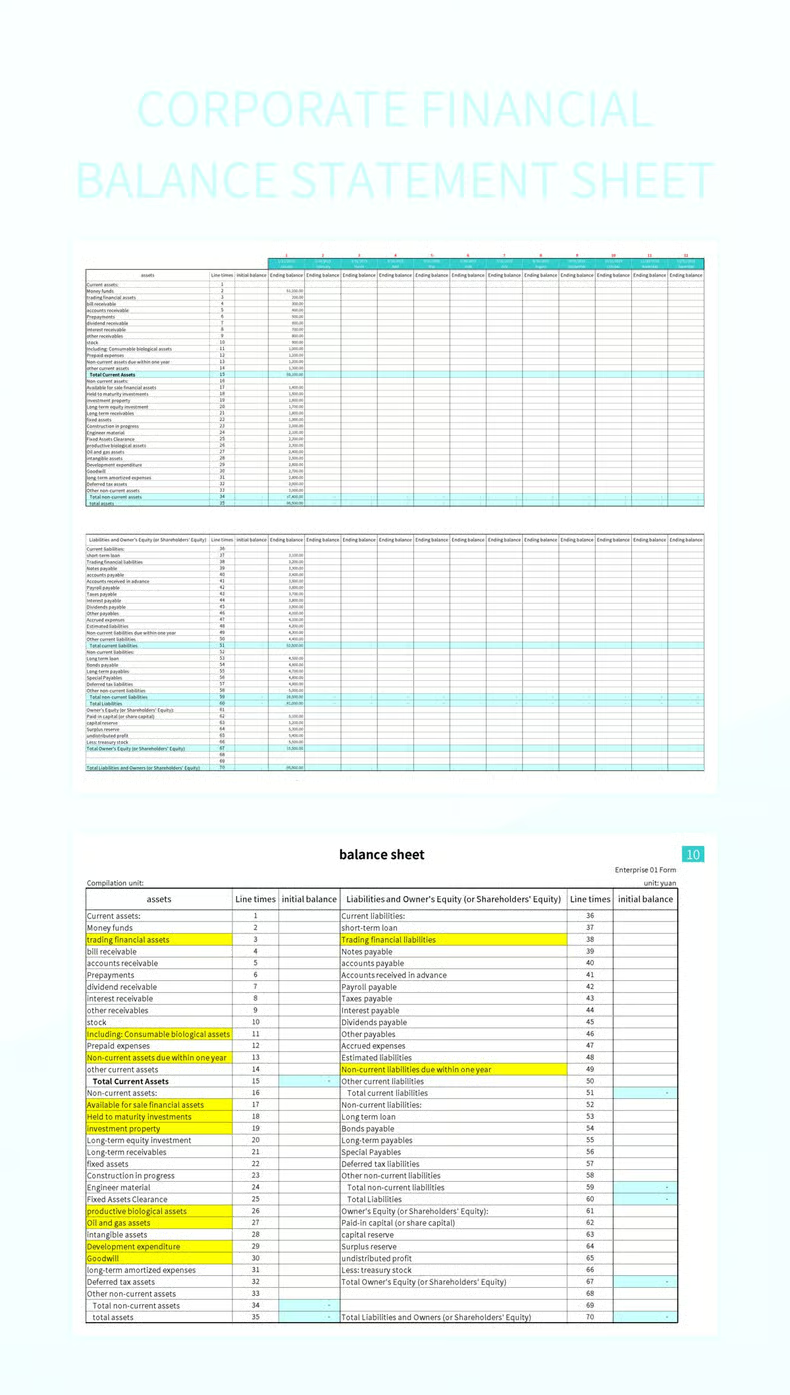
Fig 2. T-accounts are the fastest visual way to understand how debits and credits work
Step 3 — Practice Journal Entries
Journal entries are simply debits and credits written down in a structured format. Once you understand the T-account, journal entries are just the professional way of recording the same thing.
A typical journal entry for receiving $5,000 cash from a customer would look like this: Debit Cash $5,000 / Credit Accounts Receivable $5,000. Two accounts, two sides, same amount — always. The moment you can write journal entries without second-guessing yourself, you’ve crossed a major milestone in your accounting education.
According to a Quora thread by accounting professionals, the single best tip for journal entries is to focus on recurring patterns. Most businesses use the same handful of entries repeatedly — cash receipts, payments, payroll, depreciation. Master those templates first before trying to memorize every possible scenario.
Practice tip: Use a simple Excel spreadsheet — make three columns: Date, Debit Account, Credit Account. Record 20 made-up transactions. Check if everything balances. This exercise alone teaches more than hours of reading.
Fig 3. Journal entries are the core building block of all accounting records
Step 4 — Learn to Read Financial Statements
Financial statements are the final output of the accounting process — they’re the reason all those journal entries exist in the first place. There are three main ones every beginner needs to understand.
📊 Balance Sheet
Snapshot of what the business owns, owes, and the owner’s share — at one specific date
📈 Income Statement
Shows revenue, expenses, and profit or loss over a specific time period
💵 Cash Flow Statement
Tracks actual cash movement in and out — even a profitable business can run dry without this
The best way to learn these is by reading real ones. Pull up any public company’s annual report — Apple, Amazon, any big name — and find their financial statements. Don’t worry about understanding every line. Just trace how net income from the income statement connects to equity on the balance sheet. That single connection will solidify the whole picture for you.
We’ve already covered each of these in detail on this site — see our guides on the balance sheet, financial statements, and trial balance for deeper dives into each one.
Fig 4. The three core financial statements every accounting student needs to master
Step 5 — Move Into Accounting Software
Once you understand the manual process, accounting software makes everything faster — but only because you already know what it’s doing behind the scenes. This is why software comes at step 5, not step 1. People who skip the basics and jump straight into QuickBooks often don’t understand what the reports actually mean.
For beginners in 2026, here are the three most practical starting points:
| Software | Best For | Cost |
|---|---|---|
| Wave | Beginners — completely free, no credit card needed | Free |
| QuickBooks Online | Industry standard — most employers use this | Paid (30-day free trial) |
| Xero | Popular in UAE and GCC — clean interface for beginners | Paid (30-day free trial) |
Start with Wave — it’s completely free and lets you record real transactions, run reports, and see how debits/credits look inside actual software. Once you’re comfortable, move to QuickBooks because thats what most Gulf employers use and recognise on a CV.
Best Free Resources to Learn Accounting in 2026
You genuinely don’t need to spend a lot of money to learn accounting to a job-ready level. These are the best free resources available right now:
52 years of accounting education in one free platform. Covers 33 topics from basics to advanced. Has crossword puzzles, quizzes, and study guides. Genuinely the best free accounting resource on the internet.
Khan Academy — Finance & Accounting
Free video lessons on everything from basic accounting equations to financial statements. Great for visual learners who prefer watching over reading. Works perfectly on mobile.
Coursera — Beginner Accounting Courses
University of Pennsylvania and University of Virginia offer beginner accounting courses on Coursera. Audit them for free — no certificate, but the full course content is accessible at zero cost.
Free, structured written tutorials that walk through all 9 steps of the accounting cycle in clear, simple language. Brilliant for people who prefer reading over videos.
Fig 5. Free platforms like AccountingCoach and Khan Academy are genuinely enough to build solid beginner foundations
Frequently Asked Questions
This is for your information

Fig 6. Learning accounting opens real career doors across the Gulf region
Final Thoughts
Learning accounting isn’t about memorising every rule in the textbook. It’s about understanding the logic — why every transaction has two sides, why assets always equal liabilities plus equity, why cash flow matters even when profit looks healthy. Once that logic clicks, the rest is just practice.
Follow the steps in order. Start with the accounting equation. Drill debits and credits with T-accounts. Write journal entries by hand. Build simple financial statements. Then move into software. And use the free resources — AccountingCoach and Khan Academy alone are genuinely enough to get you to a job-ready level.
The accounting field is one of the most stable, well-paying career paths available worldwide — and it’s one of the few where self-study genuinely opens the same doors as a formal degree. Start today, stay consistent, and the numbers will start making sense faster than you think.
Ready to take the next step?
Browse Gulf Accounting Jobs
Put your new accounting skills to work. Explore verified finance and accounting job openings across Saudi Arabia, UAE, and Qatar.