
Tax Accounting · 2026 Gulf Guide
What is VAT / Tax Accounting Basics?
A plain-English breakdown of VAT, how it works in the Gulf, how to calculate it, and what every accountant and business owner needs to know in 2026.
📋 Key Takeaways
- VAT (Value Added Tax) is an indirect tax collected at every stage of the supply chain
- UAE charges 5% VAT, Saudi Arabia 15%, Qatar has no VAT yet but corporate tax rules apply
- Input VAT is what you pay on purchases. Output VAT is what you collect from customers. The difference goes to the government
- UAE mandatory VAT registration threshold is AED 375,000 annual turnover
- Late VAT filing in UAE can cost businesses thousands in penalties — compliance is not optional
If you work in accounting or finance anywhere in the Gulf region, understanding VAT is no longer optional — its a core part of the job. Since the UAE introduced VAT in January 2018 and Saudi Arabia raised its rate to 15% in 2020, tax accounting has become one of the most in-demand skills across the region. And with UAE corporate tax now fully in force and e-invoicing mandated from July 2026, the regulatory enviroment has never been more demanding.
But here’s the thing — once you understand the basic logic of how VAT flows through a transaction, the rest becomes a lot more manageable. This guide explains exactly that. We’ll start from the very definition, work through how VAT is calculated, then cover what you actually need to do as an accountant or business owner to stay compliant.
If you’re still building your accounting foundations, check out our guide on how to learn accounting step by step before diving into tax concepts.
What is VAT?
VAT (Value Added Tax) is an indirect tax levied on the consumption or use of goods and services at each step of the supply chain. It’s called “indirect” because the business doesn’t pay it from its own pocket — it collects it from the customer and passes it on to the government.
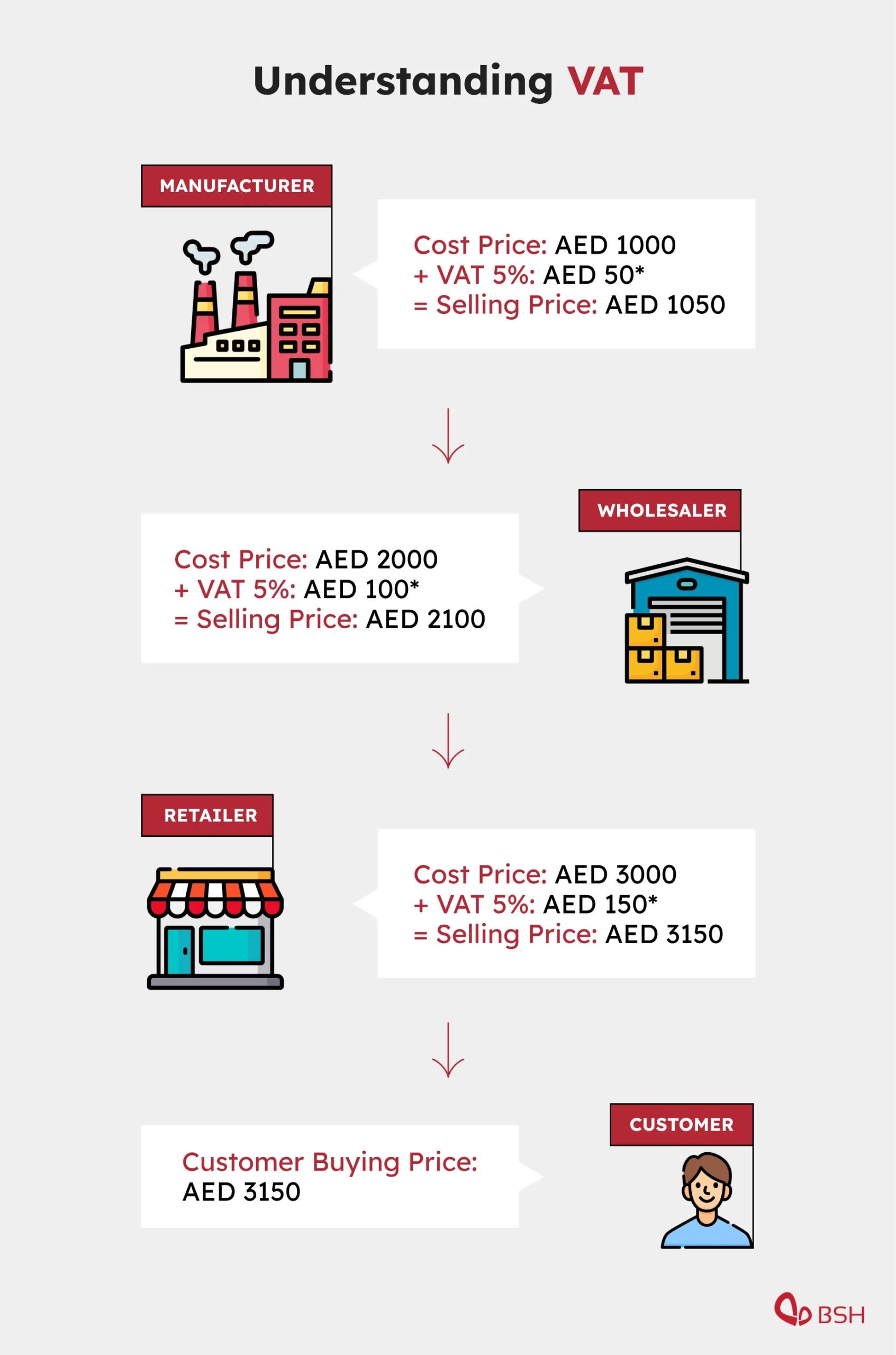
The end consumer is the one who ultimately bears the cost of VAT. But VAT-registered businesses act as the middleman — they collect it on every sale, claim back any VAT they paid on their own business purchases, and pay the difference to the tax authority.
As Zoho Books explains, VAT is charged at each step of the supply process — from manufacturer to wholesaler to retailer to customer — but each business only pays its share, the value it added.
Simple Example
A UAE business sells goods worth AED 10,000 and charges 5% VAT = AED 500 (output VAT). That same business bought supplies for AED 4,000 and paid 5% VAT = AED 200 (input VAT). Net VAT payable to FTA = AED 500 − AED 200 = AED 300.
VAT Rates Across the Gulf — 2026
Maintaining the standard rate at 5%, the UAE remains a highly competitive destination for foreign direct investment within the GCC, particularly when compared to the 15% rate currently active in Saudi Arabia. Here’s the full picture across the region:
| Country | VAT Rate | Tax Authority | Key Notes |
|---|---|---|---|
| 🇦🇪 UAE | 5% | FTA | E-invoicing mandatory July 2026 |
| 🇸🇦 Saudi Arabia | 15% | ZATCA | Fatoora e-invoicing system mandatory |
| 🇶🇦 Qatar | No VAT yet | GTA | 15% Domestic Min Top-up Tax from 2025 |
| 🇰🇼 Kuwait | No VAT yet | MOF | Expected in coming years |
| 🇧🇭 Bahrain | 10% | NBR | Raised from 5% to 10% in 2022 |
Input VAT vs Output VAT — The Core Concept
This is the single most important concept in VAT accounting. Once you understand the difference between input and output VAT, the whole system makes sense.
📥 Input VAT
VAT you pay when purchasing goods or services for your business. You can claim this back.
Example: You buy office supplies for AED 1,000 + AED 50 VAT. Input VAT = AED 50
📤 Output VAT
VAT you collect from your customers on your sales. You owe this to the government.
Example: You sell a product for AED 5,000 + AED 250 VAT. Output VAT = AED 250
The Golden Rule
VAT Payable = Output VAT − Input VAT
If your output VAT is higher than your input VAT, you pay the difference to the government. If your input VAT is higher (for example when you’ve made big purchases and had low sales), you can claim a refund from the tax authority. As ClearTax UAE explains, registered entities offset VAT on inputs against VAT on outputs, and the surplus is refunded by the authority.
Fig 3. Output VAT minus Input VAT equals the net amount payable to the government
VAT Registration — Who Needs to Register?
VAT registration is required if your local taxable supplies and imports exceed the mandatory registration threshold of AED 375,000 annually in UAE. You may also volunteer to register if your total value is more than AED 187,500. In Saudi Arabia, ZATCA administers mandatory VAT registration for all businesses exceeding the threshold.
AED 375K
UAE Mandatory Threshold
AED 187.5K
UAE Voluntary Threshold
15%
Saudi Arabia VAT Rate
5 years
Record Keeping Period (UAE)
VAT registered businesses must maintain the specified bookkeeping records for at least 5 years from the date of transaction. These records include tax invoices, credit/debit notes, bank statements, and sales and purchase summaries. Missing or incomplete records during an FTA audit can result in serious financial penalties — so keeping clean books from day one is non-negotiable.
How to Account for VAT — The Journal Entries
As an accountant, you’ll record VAT transactions in the general ledger using two main accounts: VAT Output Account (for VAT collected from customers) and VAT Input Account (for VAT paid on purchases). Here’s how it looks in practice:
| Transaction | Debit | Credit |
|---|---|---|
| Sale of AED 5,000 + 5% VAT | Cash/Receivable AED 5,250 | Revenue AED 5,000 + VAT Output AED 250 |
| Purchase of AED 2,000 + 5% VAT | Expense AED 2,000 + VAT Input AED 100 | Cash/Payable AED 2,100 |
| VAT Payment to FTA | VAT Output AED 250 | VAT Input AED 100 + Cash AED 150 |
At the end of each filing period, you reconcile the VAT output and input accounts, calculate the net amount owed, and file your VAT return via the FTA’s EmaraTax portal (UAE) or ZATCA’s Fatoora system (Saudi Arabia). The EmaraTax platform manages everything from registration to complex voluntary disclosures and allows for automated data validation.
Common VAT Mistakes Accountants Must Avoid
This compliance mistake costs UAE businesses AED 247,500 in penalties annually. Most VAT errors come from a handful of recurring mistakes — all of which are avoidable with proper systems and attention:
Filing late or missing deadlines
The VAT you collect from customers is not yours — it is the government’s money. You need to plan to make sure you pay it. UAE VAT returns are typically due within 28 days of the end of each tax period.
Claiming input VAT on blocked items
Running a Dubai restaurant? Reclaim VAT on ingredients and equipment, but not staff meals. Entertainment expenses and passenger vehicles (unless for resale) are blocked from input VAT recovery.
Issuing incorrect tax invoices
A valid tax invoice must include a unique sequential number, the supplier’s TRN, date, description of goods/services, amount, and VAT amount — separately stated. Missing any of these elements makes the invoice invalid for VAT recovery.
Misclassifying services in Saudi Arabia
Misclassifying services is costly. Classifying a technical service (5% WHT) as management fees (20%) — or vice versa — opens the door to heavy penalties.
Frequently Asked Questions
Final Thoughts
VAT accounting can feel overwhelming at first — especially with different rules, portals, and thresholds across each Gulf country. But once the core logic of input versus output VAT clicks, the day-to-day bookkeeping becomes much more manageable.
The key things to remember: collect VAT on every eligible sale, claim input VAT back on legitimate business purchases, file your returns on time, keep your invoices properly structured, and maintain all records for at least 5 years. Do these five things consistenly and you’ll stay out of trouble with the FTA and ZATCA.
VAT knowledge is one of the most valuable skills an accountant can have in the Gulf right now — and its only going to grow in demand as more countries in the region roll out new tax regimes. Understanding it deeply is a genuine career advantage in 2026 and beyond.
Looking for work in Gulf finance?
Browse Verified Finance & Tax Jobs
Find accounting, VAT, and finance roles across Saudi Arabia, UAE, Qatar, and the wider GCC region.